Showing posts with label Side Dish. Show all posts

Red Lentil Kofte / Mercimek Köftesi


This vegetarian kofte is one of the most popular appetizers of Turkish cuisine.


1 cup red lentil
1/2 cup fine bulgur
1/2 cup olive oil
2 cups of water
1 medium onion, very finely chopped
1 tsp cumin
1 tbsp tomato paste + 1 tbsp red pepper paste (if you cannot find red pepper paste you can use 2 tbsp tomato paste)
~1 tsp salt
juice of half or 1 lemon (depends on how you like it: sour or not so sour)
1/3 bunch parsley, finely chopped
1/2 bunch green onion, finely chopped
curly leaf lettuce


-Wash lentils and boil them in 2 cups of water until it almost soaks the water.
-Once you turn it off, add bulgur and salt. Mix once and cover to let the bulgur expand. Let it cool off.
-Heat oil in a pan and add the onion (not the green one!) and cook until soft.
-Add tomato paste and cook for another 1-2 minutes.
-Add cumin and stir once you turn it off.
-Add this to the lentils which should be cool by now.
-Add half of finely chopped parsley, green onion, and lemon juice to the lentils. Mix all well.
-Take walnut size pieces and give them kofte shape in your hands.
-You can either place lettuce leaves on a serving plate and put koftes on top as in the picture, or serve koftes and lettuce leaves separately. However, when you eat them you should wrap each kofte in a lettuce leaf.

Zucchini Fritters (Mücver)


Although I gave different versions of mücver recipes so far, I haven't posted "the" mücver recipe. In Turkey mücver is usually made after stuffing zucchinis, using the carvings. But it is a delicious dish on its own featuring all the fresh herbes of summer.


5-6 small firm zucchinis, grated or left over zucchini carvings from stuffed zucchinis (makes ~4 cups)
3 eggs
1/3 cup chopped flat leaf parsley
1/3 cup chopped fresh dill
2-3 tbsp or 1/4 cup chopped fresh mint (depending on how much you like mint)
3-4 green onions, finely chopped
1 cup white cheese/feta
1 tbsp paprika
salt
black pepper
~1 1/2 cup flour
1/2 cup olive oil for frying

-Put grated zucchini in a colander. Sprinkle with salt and let drain for 10 minutes. Squeeze and place in a bowl.
-Mix well all the ingredients except for flour and frying oil.
-Add flour in slowly and mix well.
-Heat oil in a frying pan. On medium drop scoops of mücver mixture in hot oil. Make sure they don't touch.
-Fry them on each side until golden brown, 4-5 minutes.
-Drain excessive oil by placing fritters on paper towels.
-Serve with plain yogurt or garlicy yogurt sauce. For garlicy yogurt sauce beat every 1 cup of yogurt with 1 clove of minced garlic.

Baked Vegetable Fritters (Fırında Sebzeli Mücver)


Mücver is usually made with zucchini and then fried, however it is way lighter to bake it in these hot and humid summer days. This is a modified recipe that uses not only zucchini but also potato and carrot. If you have other vegetables in mind like spinach, leek, etc., you can add them, too.


1 zucchini, grated
1 potato, grated
1 carrot, grated
3 spring green onions, chopped
1 green or red pepper, finely chopped
1/3 cup flat leaf parsley, chopped
1/3 cup fresh dill, chopped
1/4 cup fresh mint or basil, chopped
2 eggs
1/2 or 1/3 cup white cheese or feta, crumbled
1/3 cup, pitted 'real' black olives, chopped
2-3 tbsp olive oil
1/3 - 1/2 cup flour
2 tsp baking powder
sesame or nigella seeds


-Heat oil in a pan. Add first pepper, then carrot, then potato, and finally zucchini. Sautee until wilted, but not totally cooked.
-Transfer this mix in a bowl and let it cool down.
-Add green onion, parsley, dill, mint, eggs, cheese, olives, baking powder, and flour.
-Pour the mixture in a greased oven safe dish. Make sure the mix is not thicker than 1.5 inches in the dish.
-Sprinkle sesame or nigella seeds on top. You can also decorate it with sliced canned olives.
-Bake in a preheated oven at 400F for ~1 hour or until it gets golden brown on top or on the sides. Check with a clean knife or a wooden toothpick/skewer.

You can serve baked vegetable fritters as a side dish with dinner, with afternoon tea, or for breakfast.

Bulgur with Green Lentils and Walnuts (Cevizli Bat)


Bulgur with Green Lentils and Walnuts is a traditional recipe from a Central Anatolian city, Tokat. In Tokat's local cusine dishes with grape leaves have an important role, and this recipe is a good example. Bulgur with Green Lentils and Walnuts is a bit like kisir, but has a nuttier taste with walnuts and lentils.


1 cup fine bulgur
1 cup hot water
1 cup cooked green lentils (~1/2 cup dry green lentils would make 1 cup cooked lentils)
1/2 cup chopped walnuts
2-3 green onions, finely chopped
1/3 cup chopped parsley
1/4 cup chopped fresh dill
1 green pepper or 1/2 green bell pepper, finely chopped
2 tbsp tomato paste
1 tsp or less red pepper flakes
1 tbsp finely chopped fresh basil or 1 tsp dried basil flakes
1 tsp dry mint flakes
1 tsp or less black pepper
salt
optional a couple of cherry tomatoes

grape leaves (if unavailable, lettuce would do)

-Put bulgur in a bowl and add hot water. Stir once, cover with a thick towel and wait until bulgur soaks all the water.
-If you have fresh grape leaves, boil some water and cook grape leaves for 2-3 minutes. Set aside and let cool.
-Add tomato paste to bulgur and mix it well with the back of a spoon or your hands until paste is homogeneously distributed.
-Add lentils.
-Add green onion, parsley, dill, tomatoes, green pepper, basil, mint, red pepper flakes, black pepper, walnut, and salt.
-Serve bulgur with lentils with grape leaves or lettuce. Put some in the middle of a leave, make a roll or a bundle and enjoy.

note: Although the traditional recipe doesn't ask for it, I love adding lemon to bulgur and lentils.

Celery Root Salad with Yogurt (Yoğurtlu Kereviz Salatası)


There are two common lies that Turkish moms tell their non-celery root liking kids. If celery root is cooked, the mom forces the dish as a potato dish. The different smell and taste? Oh, it's just the spice she used! However, if celery root is to be eaten raw, as in celery root salad with yogurt, then the kid is told that it is radish salad. I loved radishes as a kid and tried this so-called radish salad served on a New Year's Eve dinner, which is a big celebration in Turkey that includes lot of drinking, turkey, numerous raki friendly salads and olive oil dishes, bingo, several kilos of fruit, and a belly dancer that appears on every TV channel exactly at midnight.


1 medium celery root, thinly grated
juice of 1/2 lemon
thick yogurt
mayonnaise
chopped walnuts
salt
dill, finely chopped
1 clove of garlic, minced
1 tbsp olive oil

-Grate celery root in a bowl.
-Squeeze lemon juice on top and mix well.
-Add enough yogurt+mayo to cover grated celery root. The ideal ratio of mayo to yogurt 1:3, however, you can change it to adopt your taste.
-Add minced garlic, chopped walnuts, dill, salt, and olive oil. Mix well.
-Cover with a clear wrap and store in the fridge for at least two hours before serving.

Purslane Tomato Salad (Pirpirim / Semizotu Piyazı)


I first had this purslane salad in Gaziantep, a city in southeastern Turkey at a kebap house. My childhood friend Özge, an archeologist by training, and I were on an archeological/historical tour covering three southeastern cities Adıyaman, Gaziantep, and Urfa. After watching the sunset at Mt. Nemrut in Adıyaman, we hopped on a minibus, arrived in Gaziantep late at night and found one of the restaurants that were recommended by friends from Gaziantep. With the first meal and baklava we had at our first stop, İmam Çağdaş kebap and baklava house in one of the narrow streets of Gaziantep, we knew that ours would be a culinary trip rather than an archeological one.

When we were served this purslane salad as a side with a variety of Antep kebaps and lahmacun--my all time favorite dish--that we sampled that night, I must admit that it did not receive the attention from us that it deserved. However, you would agree that after a long exhausting day of traveling, meeting with friends, climbing Mt. Nemrut, exploring Adıyaman, and doing all those things under the brutal southeastern sun in mid August, what one craves for is not a healthy salad. We were in the baklava and kebap capital of Turkey, after all. Two days later when we were leaving Gaziantep, we noticed that everyone on the plane, including the pilots, flight attendants, and us--of course, had at least two boxes of baklava with them, the best souvenir from Gaziantep. I had three.

Although I thought neither of us paid any attention to the purslane salad that night, I never forgot it and the perfect combination of purslane with fresh vegetables and paprika. I had the chance to have purslane salad at a dinner over at a Gaziantepli friend's house, and get the recipe. In Gaziantep purslane is called pirpirim as oppsed to semizotu, a common name for purslane in the western part of Turkey.


1 bunch purslane (~1 lb), washed and chopped in small pieces, stems discarded
1/2 bunch flat leaf parsley, finely chopped
2 tomatoes, diced
1 cucumber, peeled and thinly cut in half moon shape
1-2 green peppers (anaheim, Hungarian wax, banana, etc.), finely chopped
1 red pepper pepper, finely chopped
1 onion, cut in thin half moons
juice of half lemon
1 tsp pomegranete syrup (if you cannot find it, use juice of one lemon in stead of half)
1 tsp sumac powder or flakes
2-3 tbsp olive oil
1 tsp paprika (I used 1 1/2 tsp of a spicy variety)

-Put thin half moon shape onion in a bowl. Scatter 2 tsp salt on top. Rub onion with salt for a minute. Rinse salt off the onion with water. Drain.
-Put all the ingredients in bowl, season with lemon juice, pomegranate syrup, olive oil, sumac, paprika, and salt.


Weekend Herb Blogging, founded by Kalyn, is hosted this week by Haalo of Cook (almost) Anything at Least Once.

Carrot Salad with Yogurt (Yoğurtlu Havuç Salatası)


Carrot salad with yogurt is one of the greatly respected rakı companions. Mainly for this reason, that it's highly associated with consumption of alcohol, it's made rarely at homes by women who do not want to cause an increase in rakı consumption of their husbands, because any reason is a good reason to have rakı. Therefore, carrot salad with yogurt is made usually for big dinner parties or special occasions like New Year's eve or bayram dinners. However, you can find this simple yet delicious meze (appetizer/starter/hors d'oeuvre) at every pub that serves rakı, especially at seafood pubs. Surprisingly carrot salad with yogurt tastes even better at sloppy pubs than it does at home although it's most probably made with a low quality oil, you're lucky if it's olive oil at all, and yogurt. Yet again rakı fixes every imperfection.


serves 2 to 3 people

4 cups of grated carrot
1 cup plain yogurt, preferably whole milk yogurt
1-2 cloves of garlic, minced
2 tbsp olive oil
3-4 tbsp finely chopped fresh dill
salt
1 tbsp mayonnaise (optional)

-Heat oil in a skillet and add grated carrots. Stir until carrots are wilted.
-Put carrots in a bowl with yogurt, garlic, dill, and salt. Mix well.

Serve with crusty bread with any kind of meat.

note: At people's houses this meze is made with yogurt, but at pubs they sometimes use mayonnaise to thicken it up.

Tomato Pilaf (Domatesli Pilav)


One of the indispensable dishes of summer time dinner tables. It goes well with any kind of grilled meat and olive oil dishes.

serves 6

2 cups of rice
1 small onion, finely chopped
3 tbsp olive oil or butter
3-4 juicy tomatoes, diced and preferably skinned or 1 can of petite diced tomato
1 tsp salt
a pinch of sugar (1/4 tsp or a little more)
1 tsp black pepper (optional)
4 cups of water or stock (vegetable, chicken or beef)
finely chopped parsley to garnish


-According to the traditional Turkish style of making rice pilaf, rice is soaked in warm water for at least 20 minutes and then rinsed well to wash off the starchiness. Although I have been scolded by mom and aunts over this issue, I do not soak or wash rice for no good reason other than laziness.
-Saute onion in a pot, preferably a non-sticky one, with olive oil or butter until soft.
-Add the tomatoes and cook for 4-5 minutes until they acquire that cooked-tomato color.
-Add rice and stir for a couple of minutes.
-Add water or stock, salt, pepper, and sugar. Stir once. Turn the heat down to low once it starts boiling.
-Cover and simmer on low heat for 15-20 minutes, until it absorbs the water or stock. Do not stir it!
-Once it's cooked. Take the pot off the stove and cover the top with a paper towel or a clean kitchen cloth. Still, do not stir it. Replace the lid. Let sit covered for at least 10 minutes.
-Now you can stir or fluff it up to distribute the oil evenly that sat on the bottom. Sprinkle chopped parsley and serve hot.

Baked Zucchini with Feta (Fırında Peynirli Kabak)


Except for white cheese that's used to stuff zucchini halves, this recipe doesn't seem very Turkish or very authentic Turkish. However, I've never had this dish anywhere other than in Turkey. My mom and I usually had this kind of zucchini and baked zucchini as light summer lunches, yet I have seen it served to impress guests at parties numerous times.


4 small-medium zucchinis
1/2 cup white cheese or feta
1/4 cup mozzarella or cheddar, grated
1 egg
1/4 cup fresh dill, chopped or 1/4 cup fresh mint, finely chopped
1/4 or 1/2 cup flat leaf parsley, finely chopped
1/2 tsp black pepper
red pepper flakes
salt (depending on feta you are using)
olive oil, approximately 1 tbsp or less


-Wash zucchinis and boil them until tender but firm. Let cool down.
-Cut them in halves lengthwise to make boats. Scoop out the seedy part and save half of it to use for stuffing.
-In a bowl, mix egg, feta, mozzarella or cheddar, dill parsley, black pepper, and half of the seedy part of zucchinis until creamy.
-Load zucchini boats with the stuffing.
-Sprinkle a couple of drops of olive oil and red pepper flakes on each.
-Bake in a preheated oven at 350F for 10 to 15 minutes until cheese melts. Then broil for a couple of minutes to have a crispy top.
-Serve hot.

Fried Eggplant (Patlıcan Kızartması)


For a Turk, a summer without fried eggplant is simply impossible, unheard-of. Along with other eggplant dishes such as stuffed eggplant "split belly" , or its vegetarian version, "imam fainted," or roasted eggplant salad, fried eggplant honors our tables at least once every week. However, if you live or spend your summers on the coast, which is not very uncommon since Turkey is surrounded by seas (Aegean, the Marnara, Mediterranean, and the Black Sea), your eggplant intake might be daily; there's something about coastal weather and eggplant. Fried eggplant is the easiest eggplant dish in Turkish cuisine. The simplicity should not deceive you; it is as delicious as any complicated eggplant dish. It's always served either by a tomato or a yogurt sauce. Both sauces should be loaded with garlic.


Although this is a simple dish, there are a couple things to be careful about when cooking with eggplants. Buy eggplants right before you cook and pick the firmer ones. Eggplants tend to get soft in the refrigerator. Even though its skin is thick and sometimes bitter, do not peel it all the way; peel it lengthwise in 1/2 inch stripes. Once peeled eggplants darken fast. To prevent this you can take out the spongy middle part with seeds and keep eggplants in salty water until you cook them.


for 4 people
3 eggplants-I used regular American big eggplants, peeled as described, and diced (I prefer diced eggplants, but you can also cut them in 1/3 inch thick rounds or slices)
1-2 cups of frying oil (vegetable, corn, canola, etc.)
salt

for tamato sauce
3-4 tomatoes, petite diced or grated (or 2 cans of diced tomato--it's better if you put in a blender for a couple of seconds)
1 clove of garlic for each tomato (this is optional; you can use more or less garlic), minced
salt

for garlicy yogurt sauce
2 cups any kind of plain yogurt
2 cloves of garlic, minced

-Keep diced eggplant in a salty water until ready to fry them. Drain the water, squeeze eggplant, and dry them in a clean kitchen towel.
-Heat oil in a pot. When it's really hot put eggplant in and fry in portions.
-Fry until golden brown.
-Put a paper towel at the bottom of a plate. Take out eggplant with a slotted spoon and put over the paper towel.
-For the tomato sauce, put grated tomato, minced garlic, and salt in a pot and cook for ~30 minutes until tomato is cooked.
-For the garlicy yogurt sauce, mix well yogurt and garlic.
-You can either pour the sauce on fried eggplant on the serving plate or on your plate, the choice is yours. But do not have it without sauce. What brings the beauty of this dish is definitely garlic.
-Serve fried eggplant as a side with meat or rice. My favorite way to eat fried eggplant is to have in a fresh crusty bread. mmmmmm

bon appetit!


This recipe is my contribution to Kalyn's Weekend Herb Blogging which is hosted this week by Cate of Sweetnick.

Peppers with Cheese (Lorlu Biber)


Another great Thracian specialty! Just like menemen, peppers with cheese can also be served as a side dish, main dish, or a breakfast treat. Many people enjoy lorlu biber for breakfast, but in my family we usually have it for dinner with fresh bread. it's really easy to make, and almost impossible to make it bad.

For this recipe you can use as many peppers and as much cheese as you want. Traditionally lorlu biber is made with banana peppers. However, we got so many different kinds of peppers from this week's farmers market that I was tempted to try at least one; Hungarian wax pepper.


1 lb banana peppers, chopped in rounds (seeds taken out)
1/2 cup ricotta or farmers cheese (this can easily go up to 1 full cup)
1 cup frying oil (canola, corn, etc)
salt if needed


-Heat oil in a deep pot.
-When it's really hot, add chopped peppers and fry until they get slightly brown (If you don't want to deep fry peppers, you can stir them with 2-3 tbsp olive oil until slightly brown and then add cheese)
-Take the peppers out with a slotted spoon and place them on a paper towel to soak excessive oil. (If you will fry two different kinds of peppers and one of them is spicy; first fry the non-spicy one. Otherwise, all the peppers will be spicy)
-Put 1 tbsp of the frying oil into a non-stick frying pan. Add peppers and cheese.
-Stir until cheese starts melting.
-Serve with bread.

Thracian Roasted Eggplant Salad (Tunçilik)


Roasted eggplant salads are very common in Thrace, where I come from, during the summer. Thrace (Trakya in Turkish) is the northwestern corner or the European part of Turkey. Thrace is a historical and geographical region that spreads over Greece, Bulgaria, and Turkey. The Turkish part is the Eastern Thrace. Eastern Thrace, in years, witnessed major waves of migration--like the two big ones after the Ottoman-Russian war and the Lausanne Treaty--which created the marvelous ethnic, cultural, and culinary mosaic of the region today.

My favorite jewel of this culinary mosaic, Tunçilik, is one of the many different versions of roasted eggplant salad or meze (=appetizer) that's made in the region. Tunçilik is a specialty of the southwestern part of Turkish Thrace around Tekirdağ.


for 6 people
4 eggplants
5-6 big red peppers or banana peppers
2 tomatoes, finely chopped
4 cloves of garlic, minced
6-7 tbsp of vinegar
3-4 tbsp olive oil
salt
1/2 bunch parsley, finely chopped
There's nothing written in stone. You can use more or less of everything. Whatever you do, make sure you use all the ingredients. There's no such thing as Tunçilik without parsley, peppers, or tomatoes, or vinegar. Make it less vinegary or more oily or peppery, but have all the ingredients.


-Roast eggplants and peppers on a grill, or in oven at 450F. Roast tomatoes along with eggplants and peppers for 4-5 minutes.
-Let them cool first. Then peel eggplants, peppers, and tomatoes. And seed them.
-Chopped them all finely.
-In a bowl mix crushed garlic, eggplants, peppers, tomatoes, and parsley.
-In a small bowl, mix vinegar, olive oil, and salt. Add this on vegetables.
-Mix well. Taste. If you think you can handle a little more garlic and vinegar, do not hesitate to add more.
-Tunçilik goes well with red meat or poultry, especially if they're grilled. And do not forget to soak the juice with fresh bread.

One of the readers of the blog, Tash, has made some wonderful suggestions to perfect this recipe (also see Tash' comment below). I'd like to share them with you:
- After removing the roasted eggplants from the hot ashes, they are cut length wise, salted and kept vertically in a colander for a few minutes to drain. This I am told drains the bitter taste out of eggplants and removes excess moisture for a more consistent texture in the mix. 
-Roasted tomatoes and peppers are not always peeled to add texture and smokier taste to the mix. Just brush off the ashes. 
-If available Tahini and little lemon juice with a little roasted garlic was sometimes added to the mix.
-I also noticed that lemon juice was omitted if the roasted tomatoes were in the mix. 
-Mixing in fresh kaymak (solidified heavy cream) to the basic mix was my favorite version.


Cold Soft Wheat Berry Soup (Soğuk Buğday Çorbası)


I'm back from Turkey with great memories and recipes. The first recipe is "cold soft wheat berry soup." Although this dish is called soup, it might be served as an appetizer or a side dish. However it's served, it's a great refreshing and healthy dish for hot and humid summer days. During most summer days, my mom keeps cooked soft wheat berries ready in the refrigerator (they are usually good for at least a week). The last week of July was unbearably humid generally in Turkey and especially in my hometown; so hot and humid that our favorite pass time activity was to sit motionless in front air conditioners. During those painful days, cold soft wheat berry soup and ice cold watermelons were the only two things we could have for lunch and both felt sooo good.


soft wheat berries
yogurt
water
dried-mint flakes or finely chopped fresh mint
oregano leaves
red pepper flakes
olive oil
salt

-Boil wheat berries with a good amount of water until cooked. (You can cook more than you need for the day and keep the rest in the refrigerator for at least a week)
-Take as much as you need in a big bowl and add yogurt on top enough to cover the berries when mixed. (We always add a little more than necessary to cover berries)
-If you like a thick bowl of soup, do not add water, but if you like it thinner add some water. With this soup, everything is up to you; you can add more or less of everything.
-Sprinkle mint, oregano, pepper flakes, and salt on top.
-Add 1 or 2 tbsp of olive oil.
-Mix and serve cold.

This recipe with the dried herbs is for Weekend Herb Blogging. WHB was founded by Kalyn and is hosted by Zorra from Kochtopf.

Dill-Mint Pilaf (Dereotlu ve Naneli Pilav)


Cooking rice with green vegetables and herbs is not alien to Turkish cuisine. In her wonderful book, 500 Hundred Years of Ottoman Cuisine, Marianna Yerasimos inform us about a 16th century pilaf recipe called Dane-i Yeşil which is made with spinach, mint, parsley, dill, celery stalks, etc.

My mom wasn't raised up in the palace kitchens, yet years ago she's come up with her own green pilaf recipe. She makes this pilaf whenever we have any kind of white fish for dinner. So within the family it's known as the fish pilaf.

serves 4

1 1/2 cups of white long grain rice
1 onion, finely chopped
3 tbsp olive oil (or butter)
1/2 bunch green onion, finely chopped
1/2 bunch dill, chopped
2 tbsp fresh or dried mint
1 tbsp green peppercorn
1 tbsp pine nuts
salt
3 cups of water

-Heat oil in a pot. Stir onions, green onions, green peppercorns, and pine nuts. Cook until soft.
-Add rice and mint. Stir for 2-3 minutes.
-Add water (with most rice the ratio of rice to water is 1 to 2) and salt. Bring to a boil and then simmer on low until rice soaks the water (approximately 20 minutes)
-
Turn it off and stir half of dill. Cover the top of the pot with a paper towel or a clean kitchen towel. Place the lid on paper towel and let rice sit for at least 10 minutes before you serve.
-Scatter the rest of dill before you serve.

With all the herbs this recipes is for Kalyn's WHB which is hosted this week by Chris of Mele Cotte.

Baked Okra (Fırında Bamya)


Among the numerous delicious vegetables that I hated as a kid, okra is the only one that I still don't like. After college, I started to eat, cook, and deeply love leek, fava beans, artichokes, etc., yet even the idea of tasting okra gave me shivers. Okra is fuzzy. Okra is slimy, very slimy. Based on observation I can say people either love it or hate it. Also, okra lovers seriously believe that others would like okra if they eat a well cooked okra dish and that sliminess is due to bad cooking. What's a good way of cooking okra I don't know. The only okra dish I knew is some sort of stew. In Turkey in my house and in every other house I know okra is cooked with tomatoes, onion, and lemon juice in olive oil: nothing exciting and still slimy.
That's why I was really excited to find a new (to me) okra recipe in Sarah Woodward's book, The Ottoman Kitchen. I cannot say I liked the book. But in the end it won my favor with one recipe; for the first time in my life I ate 7 okras and really enjoyed it.


1 lb fresh okra (not the huge woody ones)
1/2 cup white vinegar
1/3 cup olive oil
1 red bell pepper, cut in thin strips
1 green bell pepper, cut in thin strips
2 onions, chopped finely
3 tomatoes, sliced in rounds
1/2 bunch flat leaf parsley, finely chopped
ground black pepper
1/2 cup water
crushed red pepper flakes
-Wash okra and dry well. Trim off the end of the stems, but be careful not to cut into the pod.
-Put okra in a large flat dish and sprinkle vinegar with generous amount of salt. Make sure both sides are coated well. Let it marinate for at least half an hour.
-Heat 2 tbsp olive oil in a skillet and cook onions until golden brown.
-Rinse okra well. Place them in rows in an oven dish; sprinkle onions.
-First put tomato slices on okras, and then crisscross pepper strips on tomatoes.
-Scatter the parsley over.
-Season with plenty of black pepper and pepper flakes. (Be careful with salt; remember okras were soaked in salt and vinegar)
-Finally pour the rest of the olive oil evenly and water.
-Bake at 375F for almost an hour. Pick one to taste; it should be soft but not very soft.
-Let it cool in its own juice and serve barely warm.
7 okras! Pretty amazing for someone who hasn't eaten even one until now. With every single bite, I wondered why I could eat okra now. The answer is the combination of vinegar and parsley. For the sake of parsley, this recipe is for Kalyn's Weekend Herb Blogging which is hosted by Rachel's Bite this week.

Turkish Tabbouleh (Kısır)


Kısır is the Turkish and different version of a Mediterranean/Arabic dish called tabbouleh. Although there are many differences between these two dishes, the main one is that the Turkish tabbouleh has tomato and pepper paste. In Turkey the recipe for kısır varies from region to region. In Adana they use more water than anywhere else or in Antakya (Hatay) they don't use water at all; they knead bulgur with tomato and pepper paste until it gets soft. However it's made, kısır is made everywhere in Turkey and is loved dearly. It is served sometimes with the afternoon tea, sometimes as a meze, and sometimes as a great summer dish you can enjoy when it's boiling hot outside.

2 cups of fıne bulgur
2 cups of hot water
1 tbsp tomato paste
1 tbsp pepper paste (preferably hot)
1/2 cup olive oil
1/2 bunch green onions, finely chopped
1 small onion, cut in thin half rounds
1 bunch flat leaf parsley, finely chopped
1 cucumber, finely chopped
2 banana peppers, finely choped
2 tbsp pomegranate syrup
juice of 1 or 1/2 lemon (you have to taste and add less or more lemon juice)
2 tsp red pepper flakes
1 tsp ground black pepper
1 tsp mint flakes
1 tsp cumin
romain lettuce leaves
tomatoes


-Put tomato and pepper paste in a big bowl and melt them with boiling hot water. Add bulgur and 1 tsp salt into this mix. Stir once. Cover with a thick kitchen towel and let it soak the water for 10 minutes.
-Cut the onion in half first, then into very thin half-moon shapes. In a little bowl, knead onion with 1 tsp salt. Rinse salt and squeeze excessive water.
-Fluff bulgur with a fork. Add pepper flakes, ground pepper, cumin, mint flakes, oil, pomegranate syrup, lemon juice, and kneaded onion. Mix well. At this point taste to see if it needs more lemon juice. Kısır should be a little bit sour.
-Add banana peppers, spring onions, cucumber, and parsley. Mix well.
-Kısır is served and eaten with lettuce leaves and tomatoes. We don't add tomatoes to kısır, because tomatoes make it mushy. So kısır is usually served on a lettuce bed (you can wrap some kısır in a lettuce leaf and eat like that) with slices of tomato on the side.

Although tabbouleh and kısır are different they have one ingredient that unites them: parsley. Parsley is a must-have both for tabbouleh and kısır. Don't even think about making tabbouleh/kısır without fresh parsley (parsley flakes would not work either) or substituting it with something else. That's why I thought this is a good recipe for WHB with its emphasis on my favorite herb parsley. WHB is back at home at Kalyn's this weekend.

Baked Zucchini (Fırın Kabak)


This is a recipe my mom and I used to enjoy for lunch during hot summer days. I had forgot about the recipe, but fortunately my mom had not. Baked zucchini is a good side dish as well as an appealing diet recipe.

3 medium zucchinis, cut in 1/2 inch rounds
1/2 bunch green onion, finely chopped 
2 tbsp dried mint
1/2 tsp pepper flakes
1/2 tsp salt
1/2 tsp ground black pepper
1/4 cup olive oil


-Mix all the ingredients in bowl and place them on a slightly greased oven dish.
-Bake for 25-30 minutes at 400F.
-Serve with yogurt on top or on the side. If you add one clove of garlic, minced, to yogurt it will be even more delicious.


Antalya Bean Salad (Antalya Usulü Piyaz)


Piyaz
is what we call bean salads in Turkey, but the term is actually Persian and means "onion." Piyaz is usually prepared with northern beans and kneaded onion; dressed with olive oil and vinegar; spiced up with pepper flakes; and decorated with tomatoes, parsley, and hard-boiled eggs. Depending on the region, piyaz might have green onions or sumac. However, in Antalya, a beautiful city with magnificent beaches and historical places on the Mediterranean coast, piyaz is made differently than the rest of Turkey. The difference is tahini and garlic, which, to my surprise since I'm not a great tahini fan, enriches the taste incredibly. In Tekirdag, my hometown, piyaz is served always with Tekirdag Meatballs. However, with tahini it can be a main dish as well.
2 cups of cooked northern beans
1 onion, cut finely in half-moons
1/2 cup parsley, finely chopped
1 tsp crushed pepper
1 or two hard boiled eggs, sliced
1 tomato, diced

1/4 cup tahini
1/4 cup vinegar
1/4 cup lemon juice
2 cloves of garlic, minced


-Soak the beans over night. Bring them to a boil and then on medium heat cook them until soft. Or use canned beans.
-In a bowl mix tahini, vinegar, lemon juice, and garlic for the sauce/dressing. It shouldn't be too runny or thick. Since different tahini brands have different density, it's hard to find the perfect mixture. If the dressing you make with the measures above is thick, add some of the water that you used to cook the beans or use the juice in the can. If it's runny than you can thicken it with more tahini.
-Pour the tahini dressing over the beans and mix them well.
-Slice the onion thinly julienne style in half moon shape. In a bowl knead it with 1 tsp salt. Rinse.
-Mix the beans with onion and parsley.
-Decorate the bean salad with tomatoes and slices of hard-boiled eggs.

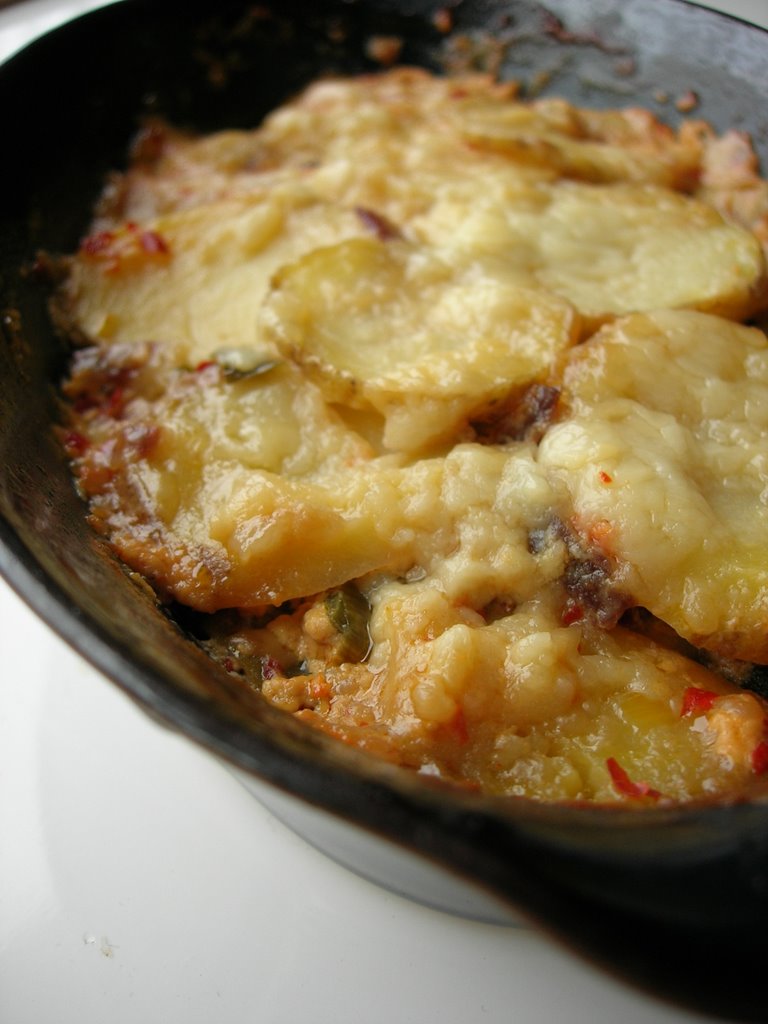
Pastirma-Leek Potato Gratin (Pastırmalı Pırasalı Patates Graten)


This is an "almost" Turkish recipe because of the pastirma. It is not easy to find Turkish or middle eastern pastirma in states, but it's not imposssible either. I buy pastirma from international markets. To see what pastirma looks like click here.

-pastirma is optional

1 pound/bag of baby potatoes, red or golden peeled and sliced thinly
2 leeks, chopped finely
10 strips of pastrami, cut in thin slices (you can have more or less)
1 cup cream
1 1/2 cup vegetable stock
3 cloves of garlic, minced
2 bay leaves
black pepper
pepper flakes
salt
1 cup or more crumbled feta or grated cheddar cheese

-Grease an oven pan (I used an 11 X 9 inch one) and place one layer of potatoes. Season with salt, black pepper, pepper flakes, and garlic. Sprinkle half of the leeks and pastrami. Put another layer of potatoes. Season with salt, black pepper, pepper flakes, and garlic. Add the other half of leeks and pastrami. Finally, put the last layer of potatoes. (With less ingredient, you can easily have only two layers of potatoes)
-In a little pot mix cream, stock, and bay leaves. First bring them to a boil and then turn it off.
-Top with grated cheese. Pour the creamy mixture on top (take the bay leaves out). Bake in a preheated oven at 400 F for 40-60 minutes loosely covered with an aluminum foil. For a crispy top, uncover and broil for 5 -10 minutes or until lightly brown.

This is a recipe I tried for a Turkish food blogging event "Patates Ye" (Eat Potatoes) which is hosted by Evren of Annemin Mutfak Kokusu (the smell of my mom's kitchen).

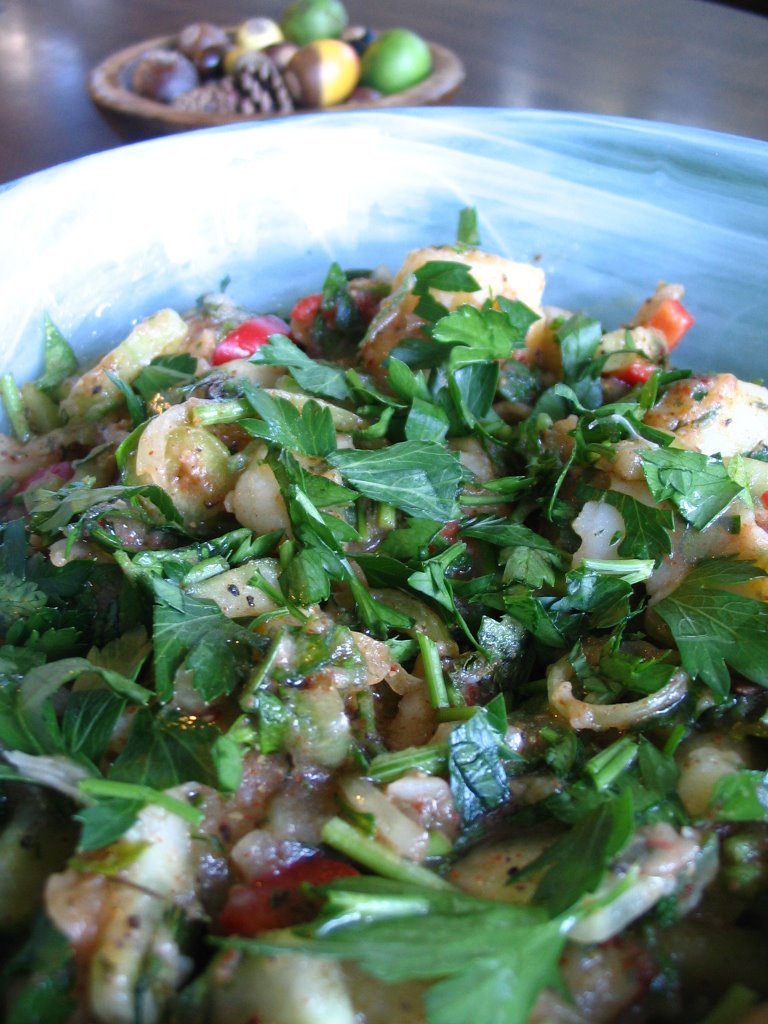
Potato Salad à la Turque (Patates Salatası)


Another parsley recipe for this week's Weekend Herb Blogging which is hosted by Sher of What Did You Eat? Although parsley seems to be the dominant herb in this salad, the recipe shows the friendship of herbes

4 medium potatoes--in Turkey this is made with yellow potatoes since we don't have red ones over there; however, I love it with red potatoes,too--peeled and diced (actually the number of potatoes depends on how big a salad you want)
1 small onion
1/2 bunch green onions, chopped
1 cucumber, cut in quarter rounds
2 banana peppers (or any other green/red pepper), chopped finely
1/2 bunch parsley, chopped
1/4 cup dill, chopped
1/3 cup fresh mint, chopped or 2 tsp dried mint flakes
1/2 tsp red crushed pepper
1 tsp sweet paprika
1 tsp sumack
1/2 tsp black pepper
juice of one and a half lemons
1/3 cup olive oil
salt

-Peel, dice, and then boil the potatoes in salted water for approximately 10 minutes. Drain and let cool
-Cut the onion in half lengthwise and then chop it into very thin half moons. Put the chopped onion in a bowl and knead it with 1 tsp salt until the onion is soft. Rinse the salt off the onion
-Mix all the ingredients in a big bowl

Serve as an appetizer, salad, or as a side dish for meat